
PART 4
The moment I saw the compass, the last uncertainty left me.
“Owen Pike,” I said.
Mateo grabbed the cockpit frame.
“The warehouse clerk?”
“The man who loaded the case.”
Below us, Frost Station Nine glowed against the ice like a handful of embers trapped in a white desert. The runway lights were on, but they were not aligned correctly. Four lamps had been shifted six degrees east, enough to make a landing approach look safe while guiding an aircraft toward the old fuel trench.
Someone had prepared the station for a crash.
The hostile fighters were not retreating. They were taking positions beyond the clouds, waiting for us to descend.
Colonel Vale came over the radio.
“Elena, abort the approach.”
“If I turn away, they launch.”
“Let them launch. We have your position.”
“No. You have my position. They have the station.”
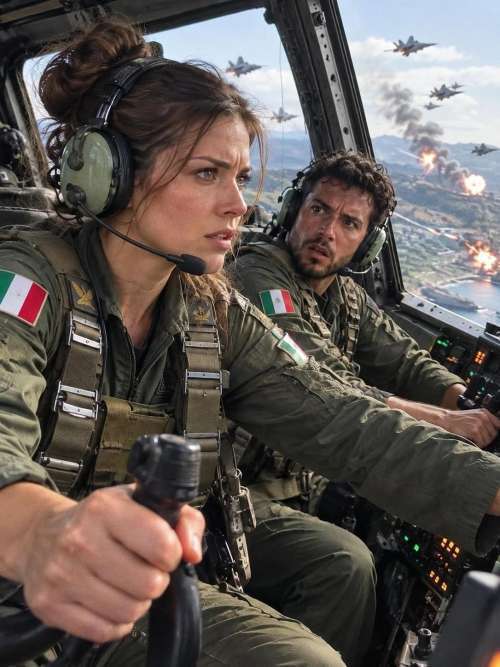
I turned the damaged Spartan toward the runway.
Mateo pulled himself into the copilot seat and began checking the landing gear.
“Left gear is showing red,” he said.
“It has been red for twelve minutes.”
“I was hoping it would become less red.”
“Hope is not a maintenance procedure.”
“You’ve become very difficult since the missiles started.”
“I was difficult before.”
The runway rushed toward us through the snow.
I lowered the landing gear. The left wheel refused to lock.
Below the aircraft, a vehicle crossed the perimeter fence and stopped beside the station’s communications tower. A man stepped out. Even from altitude, I recognized the brass compass on his vest.
Pike looked up at us.
Then he raised one hand.
The station beacon went dark.
The runway disappeared.
For a breath, we were flying toward a black sheet of ice with no lights to guide us.
“Mateo,” I said, “open the cargo ramp.”
He stared at me.
“At this altitude?”
“Do it.”
The rear ramp began to descend, and the wind tore through the cargo bay. Inside, the unsecured hydraulic pump broke free and slammed across the deck. The plasma containers held for one second, then two.
Mateo crawled backward on his knees, fighting the wind.
“What are you trying to do?”
“Give them something else to chase.”
I kicked the rudder and rolled hard. The open ramp changed the airflow behind us, producing a violent, uneven wake. Then I released the empty external fuel drum mounted beneath the cargo bay.
It dropped into the darkness.
The hostile aircraft detected its heat signature and moved instantly.
Three fighters dove after it.
The remaining five stayed with us.
“Nice trick,” Mateo said.
“It bought us four seconds.”
“Four seconds is not a trick. It’s an insult.”
I used those four seconds to land.
The right gear touched first. I held the left wing high until the last possible moment, then settled the aircraft onto the frozen runway with a shower of sparks. The damaged wheel folded as soon as it met the ice. The Spartan slewed sideways, crossed the runway, and smashed through a snow barrier.
The cockpit stopped with the nose buried in a bank of packed ice.
For several seconds, neither of us moved.
Then the cargo alarm began to pulse.
Mateo unbuckled himself.
“Are you alive?”
“I’m offended.”
“That wasn’t my question.”
“I’m alive.”
The rear hatch opened onto a storm of snow. I took the titanium case from its restraints and felt its weight against my ribs. The red security band was still intact.
Outside, alarms were screaming across the station.
Not attack alarms.
Evacuation alarms.
Frost Station Nine had only one functional shelter, and someone had locked the main access doors from the inside.
Mateo pointed toward the communications tower.
Pike was running.
I followed him.
The wind struck like gravel. Snow filled my eyes, and the cold found every gap in my flight suit. Behind us, engines roared as the hostile fighters circled low over the station, unwilling to fire while we were among their own target.
Pike reached the tower first.
He entered the access hatch and pulled it shut.
I hit the door with my shoulder.
“Pike!”
His voice came through the metal.
“Captain Morales, you should have stayed in the air.”
“You changed my route.”
“You were the only pilot who could survive it.”
“You killed Gabriel.”
A pause.
“No,” he said. “I gave him a chance to live.”
Mateo looked at me.
I felt my hand close around the case handle.
“Open the door.”
“He was going to expose the network. Ward ordered the strike.”
“Lucian Ward?”
“He was never a station commander. He was the buyer.”
The hatch opened.
Pike stood inside with a pistol lowered toward the floor. His face was raw from the cold. The brass compass hung from his vest, its cracked glass catching the red emergency lights.
“I worked for Ward,” he said. “I thought he wanted the defense core to sell. I didn’t know he planned to shut down every station and let the northern corridor collapse.”
“Why betray him now?”
“Because Gabriel found me before the mission. He knew I had altered the route. He could have reported me.”
Pike’s jaw tightened.
“He told me to watch the people who gave orders from warm rooms.”
The words hit somewhere deep.
“Where is Ward?” I asked.
Pike pointed upward.
“Inside the command room. He has the station crew locked in the shelter and the launch aircraft fueled.”
Mateo checked his sidearm.
“How many guards?”
“Four.”
“Armed?”
“All of them.”
Pike looked at me.
“And Ward has the station’s emergency authority. If he reaches the launch aircraft, the core will never be safe.”
I handed Mateo the case.
“Take this to the shelter.”
He shook his head.
“You’re going after Ward alone?”
“I know the command room.”
“You’ve never been there.”
“Gabriel’s report described it.”
Pike stared at me.
“That report was sealed.”
“Gabriel sent me a copy before he died.”
I had never told anyone.
Not Colonel Vale. Not my commanding officer. Not even Mateo.
Gabriel had mailed the report inside a maintenance manual three days before his final mission. I had read it once, then hidden it because every page contained the same conclusion: the enemy was not only outside the wire.
The report named Lucian Ward.
The signature at the bottom was the reason Gabriel had been silenced.
Ward’s own.
Pike led us up the tower stairs. Halfway to the command level, the lights failed. A gunshot cracked above us. Metal rang. Mateo shoved me against the wall as a round struck the railing where my head had been.
“Back!” he shouted.
I counted the footsteps.
One guard moved left. Another stayed near the landing. Two were behind the command room door.
Old training returned without permission.
I grabbed a fire extinguisher, pulled the pin, and rolled it up the stairs. The guard fired at the cylinder. Pike came around the corner and struck him with the brass compass, hard enough to split the skin above his eye.
Mateo took the second guard’s weapon.
The command room door opened.
Lucian Ward stood behind the glass partition, tall and silver-haired, wearing the white uniform of a station commander. He held a detonator in one hand and a folded sheet of paper in the other.
“Elena Morales,” he said. “You should have remained a cargo pilot.”
I walked into the room.
“You should have learned to read your own handwriting.”
He lifted the paper.
Gabriel’s mission report.
“You think this proves anything?”
“It proves you signed the order sending him into an ambush.”
“He chose to continue.”
“You disabled his rescue channel.”
Ward’s expression tightened.
Pike stepped beside me.
“I saw the order,” he said.
Ward turned toward him.
“You were paid to forget.”
“I was paid to load a case.”
“You were paid because your family needed the money.”
Pike’s hand trembled, but he did not lower his weapon.
Ward pressed the detonator.
Nothing happened.
He pressed it again.
Colonel Vale’s voice filled the room through the station speakers.
“Lucian Ward, your command authority has been revoked.”
Ward looked at the console.
Vale continued, “The signed order, the altered route, and the emergency launch request were transmitted to every allied command station before your beacon went dark.”
Ward stared at the dead detonator.
I understood the final piece.
Pike had not merely betrayed Ward by opening the tower door. He had inserted the cracked compass into the beacon housing, using its metal casing to bridge the emergency circuit. The station had sent one last burst of data before the lights failed.
Ward had exposed himself by shutting down the beacon.
The fighters outside broke formation.
Two allied aircraft cut through the cloud above the station. Their engines rolled across the ice like thunder.
Ward moved toward the launch controls.
I blocked him.
“Move.”
“No.”
“You don’t understand what happens if that core remains here.”
“I understand exactly what happens if you take it.”
His eyes flicked toward the case in Mateo’s hands.
Then he lunged.
I caught his wrist and turned with the motion. He struck the console. The detonator flew across the floor. Ward was stronger than he looked, but he had never spent five years learning how to fight inside a cockpit while the world spun around him.
I used his momentum.
He hit the deck hard.
For a moment, his face was inches from mine.
“You killed Gabriel,” I said.
He breathed through his teeth.
“I gave the order.”
The admission hung between us.
Pike closed his eyes.
Mateo looked at me, waiting for what I would do.
I wanted to hit Ward until the six lost years became visible on his skin. I wanted Gabriel to walk through the door, grin at me, and call the whole thing a bad dream.
Instead, I took the folded report from Ward’s hand.
“You don’t get to make me become what you made him fight.”
Ward’s face changed then, not with fear, but with the understanding that his last weapon had failed.
The station crew came out of the shelter when the locks released. Colonel Vale landed twenty minutes later with the allied fighters, and the hostile aircraft vanished northward before they could be intercepted.
Their attack had failed. Their target was secure. Their commander had no authority left to hide behind.
Pike surrendered the brass compass to Vale as evidence, then asked whether the station would still need a loading clerk.
Vale looked at him for a long moment.
“Not a clerk,” he said. “A witness.”
Mateo carried the titanium case into the command room and placed it beneath the central console. I entered the authentication code Gabriel had left in the margin of his report.
The defense network came back one station at a time.
Green lights appeared across the northern map.
One by one.
Frost Station Nine remained damaged, the Spartan was ruined, and the truth about Gabriel’s death could never return the years stolen from us. But his final instruction had reached the person he trusted.
Me.
Colonel Vale found me beside the wreckage before dawn.
“You can return to transport duty,” he said. “No one will question it.”
I looked at the aircraft, at the torn wing and the blackened engine.
“Good.”
He waited.
“I’m not leaving transport,” I added. “But I’ll train the next crews.”
“For what?”
I picked up the cracked brass compass from the snow and handed it to Pike.
“For the day someone decides a cargo plane is harmless.”
Pike closed his fingers around it.
The needle still pointed south.
I walked back to the Spartan, where Mateo was removing the last intact restraint from the cargo deck.
He held up the torn manifest.
“What should I write under mission result?”
I looked at the ruined aircraft, the restored station, and the gray horizon where the fighters had disappeared.
“Write this,” I said. “Mule 44 delivered.”
Missed the beginning?