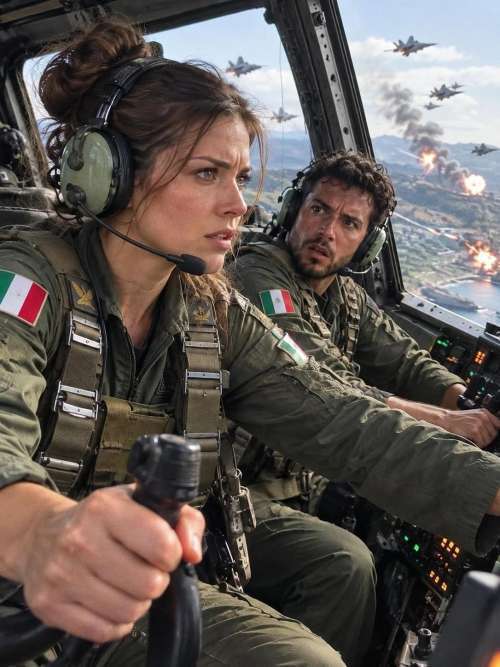

The first missile passed so close to my cockpit that its heat turned the left window milky white.
I did not scream. I pushed the damaged Spartan into a hard roll, felt the shoulder harness cut into my collarbone, and watched the missile vanish beneath us in a boiling streak of orange.
Behind me, something heavy crashed across the cargo deck.
“Captain, the plasma cases are loose!” Sergeant Mateo Ramos shouted through the intercom. “We’ve lost the port restraints!”
“Secure them manually.”
“With what? The aircraft is trying to kill us!”
“So are the fighters. Choose the easier problem.”
The C-27J shuddered like an old truck crossing broken ice. Warning lights flickered across my instrument panel. The left engine was coughing smoke into the freezing air, and the propeller blades were turning unevenly enough to make every vibration feel like a countdown.
Outside, the fog over the Norwegian Sea opened for half a second.
Eight aircraft moved inside it.
They were dark shapes without visible markings, sliding through the cloud bank with the cold precision of machines built to erase people. Their radar signatures appeared and disappeared around me, never holding the same distance twice. Whoever was flying them had studied our aircraft, our route, and every weakness in our airframe.
They had not studied me.
“Mula 44, this is Spear Control,” a strained voice cut through the interference. “We have two allied fighters inbound. Seven minutes.”
“Tell them to hurry.”
“Can you maintain altitude?”
I looked at the engine gauges. One needle trembled below the red line. The other was climbing toward it.
“I can maintain something.”
Mateo came forward from the cargo bay, gripping the edge of the cockpit doorway. Blood ran from a cut above his eyebrow, bright against the pale skin around it.
“You said this was a routine supply run,” he said.
“It was.”
“Routine supply runs don’t usually attract eight stealth fighters.”
“That depends on the supplies.”
His eyes moved toward the cargo hold.
For one second, neither of us spoke.
The official manifest listed blood plasma, satellite communication modules, and a hydraulic pump destined for Frost Station Nine. But tucked behind the second row of insulated containers was a narrow titanium case sealed with a red security band. I had been ordered not to open it, not to discuss it, and not to let it leave my sight until the station commander signed for it.
Even the logistics officer who handed me the case had avoided looking at it.
Now the enemy was risking eight advanced fighters to keep us away from an isolated Arctic station.
The answer sat behind Mateo’s shoulder.
“Captain,” he said quietly, “what exactly are we carrying?”
“Something people are willing to kill for.”
“That was not comforting.”
“It wasn’t meant to be.”
A tone shrieked in my headset.
One of the fighters had dropped beneath us. Another was climbing directly toward our blind spot. The remaining six spread wide, forming a closing net.
The old me would have recognized the pattern immediately.
The woman who had flown the Typhoon would have known the angles, the timing, the trap hidden inside the formation.
But that woman had been buried six years earlier, alongside my younger brother Gabriel, whose coffin had arrived from overseas under a folded national flag.
I had left combat aviation three weeks later.
I had traded nine-g turns for cargo manifests and missile threats for frozen loading ramps. At the base cafeteria, the fighter pilots called me Mule 44 because they believed a transport pilot was only a driver with wings.
I let them believe it.
Then the lead fighter crossed my nose and fired.
“Mateo,” I said, “strap down everything that can move.”
“I already did.”
“Then strap yourself down tighter.”
“Why?”
I lowered the nose toward the dark ocean.
“Because I’m about to make eight very expensive aircraft regret coming this close.”
The radar warning screamed again. Two missiles broke from the cloud, racing toward my cockpit as the sea rose beneath us and the damaged engine began to fail…
PART 2
The missiles were not aimed at where I was. They were aimed at where their computers predicted I would be.
That was their mistake.
I pulled the power from the good engine and kicked the rudder hard enough to make my boot slide against the pedal. The Spartan lurched sideways, not down, while the damaged engine spat a sheet of fire past the wing.
The first missile passed above us.
The second struck the ocean less than a hundred yards away.
A wall of seawater rose beside the fuselage and slammed into the windows. The cockpit went black for one breath. Then the emergency instruments glowed red again.
Mateo cursed behind me.
“Are we still flying?” he asked.
“Technically.”
“Could you use a more encouraging word?”
“Certainly. We are still not falling.”
The aircraft bucked as fragments of ice and water hammered the fuselage. Somewhere behind us, a cargo latch tore free. I heard metal scrape across the deck.
“Captain!” Mateo yelled. “The titanium case moved!”
“Do not open it.”
“I’m not planning to. I’m planning to keep it from becoming a projectile!”
The radio crackled.
“Mula 44, Spear Two approaching from the west. We have visual on hostile aircraft. Break east immediately.”
“I can’t.”
“Repeat?”
“I have a damaged engine, unstable cargo, and eight aircraft between me and the station.”
“Then turn south.”
I glanced at the navigation display. South would take us toward open sea and away from Frost Station Nine. It would also abandon the cargo, the station, and the people waiting there with only six hours of emergency power remaining.
“I’m continuing north.”
The controller’s voice tightened.
“Captain Morales, that is an order.”
A fighter swept past the cockpit, close enough for me to see its matte-black surface and the faint silver edge of its canopy. It did not fire. It simply watched me, as if the pilot wanted me to understand that the next pass would be different.
I remembered another cockpit. Another voice. Gabriel laughing over the radio because I had beaten him through a mountain training course by less than a second.
You always look where the enemy wants you to look, Elena.
He had said it like a joke.
It had not been one.
“Captain,” Mateo said, “the aircraft on our left is not attacking.”
“I know.”
“It’s guiding the others.”
“I know.”
“Why does that sound worse?”
“Because it is.”
The fighters shifted formation. Three climbed. Two dropped below us. The remaining aircraft moved ahead, creating a corridor through the fog.
They wanted to herd us somewhere.
My eyes moved over the weather display. A violent storm front lay north of our route, invisible beneath the electronic interference. The fighters were pushing us toward it, toward air too turbulent for their own stealth systems but deadly for a damaged transport.
The trap was elegant.
I smiled without humor.
“Captain, why are you smiling?” Mateo asked.
“I’m not.”
“You are. I can see it in the reflection.”
“I just remembered something.”
“What?”
“Pilots hate being predictable.”
I dropped the aircraft below the storm layer.
The Spartan entered the clouds like a stone thrown into boiling water. Rain and ice struck the windshield. The wings vanished. The instruments flickered. The aircraft rolled left, then right, while Mateo braced himself against the cockpit frame.
Behind us, the fighters hesitated.
Their radar could follow a clean target. It could not easily track a transport disappearing inside a moving wall of ice while one engine failed and the other ran at dangerous power.
I used the old tactics I had sworn never to use again. I changed altitude without changing speed. I allowed the aircraft to sink, then caught it inches above stall speed. I turned through the storm’s rising currents, using turbulence as a weapon.
One hostile aircraft emerged too close behind us.
I pulled into its path, then dropped abruptly.
The fighter shot over the top of the Spartan and vanished into cloud.
Mateo let out a breath.
“Who taught you to fly like that?”
I kept my eyes forward.
“My brother.”
A new voice entered the radio. It was older, sharper, and suddenly very quiet.
“Elena?”
My hand tightened around the controls.
Only one person in the entire northern command had ever called me by my first name over an open tactical channel.
“Identify yourself,” I said.
“You know who this is.”
The voice belonged to Colonel Adrian Vale, commander of the wing I had left after Gabriel died.
He continued before I could answer.
“The fighters aren’t trying to destroy your aircraft. They’re waiting for you to reach the station.”
Mateo looked at me.
I felt the cold inside my chest deepen.
“Why?” I asked.
Vale’s reply came through beneath a burst of static.
“Because the person who betrayed your flight plan is already inside Frost Station Nine…”
PART 3
For three seconds, the only sound in the cockpit was the uneven growl of the engines.
“Say that again,” I ordered.
Colonel Vale’s voice returned, distorted but clear enough.
“Your route was changed at 0410. The official system shows my authorization, but I never signed it. Someone used my command code to send you directly over the patrol corridor.”
Mateo stared at the titanium case through the open cockpit doorway.
“Then they knew what was on board,” he said.
“Not just that,” Vale answered. “They knew when you would arrive.”
A flash of lightning lit the cloud below us. For an instant, the eight fighters appeared like black needles around the storm.
“Who has access to the route?” I asked.
“Four people at Northern Logistics. Two at the station. And one person on your aircraft.”
Mateo’s face hardened.
“You think it’s me?”
“I think the leak came from the loading team,” Vale said. “Your manifest was opened six times after you signed it.”
I remembered the logistics officer who had delivered the titanium case. His name was Owen Pike. He had worn a brass polar compass clipped to his vest, its glass cracked across the center. When I asked why a warehouse clerk carried a military compass, he had smiled and said it belonged to his father.
I had noticed the compass because its needle had been pointing south.
Now I remembered something else.
Pike had not sealed the case. He had watched me do it.
“Colonel,” I said, “what is inside the case?”
Vale did not answer immediately.
“Your brother died protecting the original design,” he said.
My fingers went numb around the controls.
“Gabriel died six years ago.”
“He died stopping a theft from the Arctic defense network. The stolen material was never recovered.”
The titanium case seemed to grow heavier behind us.
“What did you send me?”
“The recovered command core.”
Mateo swore under his breath.
Vale continued, “It can authenticate every remote defense station in the north. In the wrong hands, someone could blind the entire region without firing a shot.”
“So those fighters are here for the core.”
“They are here to force you down before you reach the station.”
One of the hostile aircraft fired again.
The missile streaked through the cloud and curved toward us. I pushed the nose down, then rolled underneath it. The missile passed above the cockpit and detonated against the storm, shaking the aircraft so violently that the overhead panels burst open.
“Captain,” Mateo shouted, “we’re losing pressure!”
“Mask on.”
He obeyed, but his eyes remained fixed on me.
“You knew your brother’s death was connected to this?”
“I knew only what they allowed me to know.”
“Why send you?”
That question struck harder than the explosion.
Vale answered before I could.
“Because Gabriel left one final instruction.”
The radio hissed.
“What instruction?”
“He said that if the command core was ever recovered, it had to be flown by the person who understood the enemy’s formation better than the people who built the aircraft.”
I closed my eyes for half a heartbeat.
Gabriel’s voice came back to me, warm and teasing, from a training room filled with maps.
You don’t win by having the fastest machine. You win by making the other pilot choose between two bad decisions.
I opened my eyes.
The fighters were no longer surrounding us.
They were retreating toward the station.
“Why are they breaking off?” Mateo asked.
I looked at the navigation display.
A small green symbol had appeared on the emergency channel. Frost Station Nine had transmitted its landing beacon.
But beneath it was another signal, one I recognized from the old combat network.
The station had issued a launch authorization for an aircraft that did not exist on the day’s manifest.
Someone inside the station was preparing to receive the core without waiting for me.
“Colonel,” I said, “what is the name of the station commander?”
Vale went silent.
Then he said, “Commander Lucian Ward.”
Mateo looked at me.
“Is that bad?”
I watched the false beacon pulse on my display.
“Gabriel’s last mission report was signed by Lucian Ward.”
The storm opened beneath us, revealing the lights of Frost Station Nine on the ice shelf.
At the end of the runway, a second aircraft was already warming its engines.
And beside it stood a man wearing a cracked brass compass whose needle pointed south…
Ward saw the name beneath the emergency order — and froze…
I thought surviving the fighters was the hard part. I was wrong. The truth waiting inside Frost Station Nine changed what I believed about Gabriel’s final mission.
“Gabriel was never meant to return.”
The room seemed to tilt beneath me.
👇 The final part of the story is already open.
