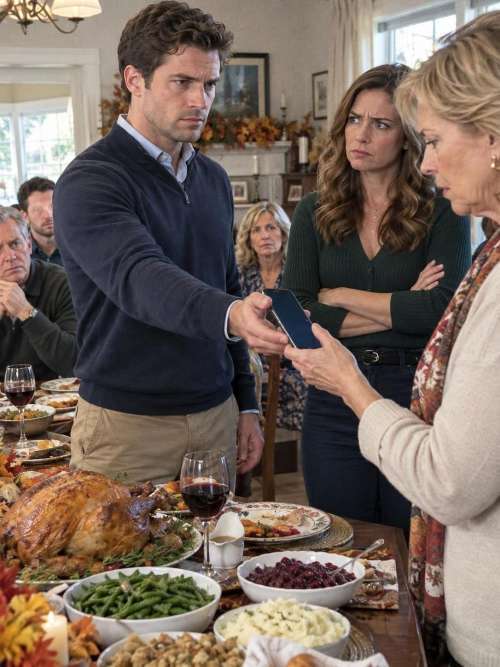

By the time my aunt Linda served the pumpkin pie, my cousin Sarah had already spent my money three different ways.
She sat beneath the brass chandelier in Linda’s dining room, tapping one manicured finger against her coffee cup. The cup had a tiny gold crack near the handle, and every time she touched it, porcelain clicked against the saucer.
“So, Zach,” Sarah said, loud enough for everyone to hear, “how much did you actually make this year?”
The room tightened around the question.
My uncle Ray stopped cutting his pie. Linda’s hand froze above the whipped cream. My mother looked down at her napkin as if the embroidery suddenly required urgent study.
“I’m doing well,” I said.
“That isn’t an answer.” Sarah smiled. “People are saying you made millions.”
The word landed harder than the plates had when we sat down.
I had kept the money private for a reason. A software project I had helped build at work had been bought by a larger company, and my share had changed everything. But I still lived in my one-bedroom apartment, drove my eight-year-old sedan, and wore the same brown watch with the scratched leather strap.
Money had arrived quietly.
My family had not.
Ray leaned back and lifted his wineglass. “Must be convenient. Some of us are drowning.”
“I’m sorry to hear that,” I said.
Linda finally found her voice. “Ray is behind on the mortgage. Sarah has tuition payments. We thought you might help.”
“Help how?”
Sarah placed her fork beside her plate. “You could clear the mortgage. It would barely touch what you have.”
Ray nodded. “And Linda needs money for the college account.”
Linda gave him a sharp look, but it was too late.
I stared at the turkey carcass in the center of the table, its skin shining beneath the dining room lights. For years, these people had called me only when they needed a favor, a ride, a signature, or an apology from someone else. Now they were assigning numbers to my kindness.
“I’m not paying anyone’s debts,” I said.
Sarah’s smile vanished. “Why are you being cruel?”
“Because I said no?”
“You have more than you need.”
“That doesn’t make it yours.”
Linda pressed both palms flat against the table. Her wedding ring scraped the wood. “Family is supposed to support family.”
“Support isn’t the same as surrender.”
Ray snorted. “You think you earned all that alone?”
Something old moved inside me—the reflex to explain, apologize, and make everyone comfortable. I had spent my childhood doing that. Linda would sigh, Sarah would accuse, and I would become smaller until the room settled.
Not this time.
I placed my glass beside the cranberry sauce and stood.
“Actually,” I said, “I have a better idea.”
Sarah folded her arms. “This should be good.”
“I’m done being treated like the family emergency fund.”
Linda gasped. “After everything we did for you?”
I looked at her. “What exactly did you do?”
Nobody answered.
The refrigerator hummed in the kitchen. Somewhere under the table, a fork rolled against a chair leg.
Sarah’s face flushed. “You can’t walk away while your family needs you.”
“Watch me.”
I picked up my coat and left before anyone could turn the moment into another argument.
The first message arrived before I reached my car.
You’ve changed.
The second came while I was waiting at a red light.
We raised you. You owe us.
By midnight, three relatives had posted about a selfish man who had forgotten where he came from. By morning, an aunt I had not spoken to in two years had called me greedy.
I ignored them until Sarah called on Tuesday night.
“You owe us,” she said.
“No, Sarah.”
“You’ll regret humiliating everyone at Thanksgiving.”
“I didn’t humiliate anyone. I refused to pay their bills.”
Her breath sharpened. “Then we’ll make sure the whole family knows what you really are.”
The call ended.
Three days later, she sent me an invitation that looked less like a family meeting than a summons. At the bottom, she had typed: Come prepared to explain yourself.
I went to Linda’s house at seven o’clock on Friday evening. The kitchen lights were painfully bright. A copper pan hung above the stove, and the air smelled of burnt coffee.
Sarah sat at the table with her arms crossed. Linda stood beside a folder bound with a red elastic band.
“Well,” Sarah said, “you actually came.”
“I said I would.”
Linda pushed the folder toward the empty chair. “We want to discuss a reasonable arrangement.”
I sat down but did not touch it.
Sarah leaned across the table. “You have money. We have obligations. This can end peacefully.”
“And if I say no?”
Linda’s fingers tightened around the edge of the counter.
“Then you’ll learn,” she said, “what happens when family stops protecting you.”
I reached into my pocket and placed my phone beside the folder.
Sarah frowned. “What are you doing?”
I unlocked the screen and opened the document I had prepared that morning.
“If you want my help,” I said, turning the phone toward them, “these are my terms.”
Linda bent over the screen. Her eyes moved across the first page, then stopped.
The color drained from her face.
Sarah stood up so fast that the chair struck the wall.
“What is this?” Linda whispered…
PART 2
“What is this?” Linda whispered.
Her hand hovered above my phone without touching it. The red elastic around the folder trembled as if someone had pulled it from inside.
Sarah looked from the document to her mother. “What did he write?”
“Read it,” I said.
Linda’s eyes slid down the page. “You want us to sign a repayment agreement?”
“Not exactly.”
Sarah snatched the phone from her hand. Her perfume filled the narrow space between us, sharp and sweet enough to make my eyes sting.
The document was only two pages. The first required a complete list of every debt they wanted me to pay, including the lender, original amount, current balance, and purpose. The second required them to acknowledge that any money I gave would be a conditional gift, not an obligation, and that they would stop using my name to pressure relatives or collect donations.
At the bottom was one additional line.
They had to explain what happened to the money left for my education after my father died.
Sarah read it twice.
Linda reached for the phone. “That has nothing to do with this.”
“It has everything to do with this.”
Ray appeared in the kitchen doorway. I had not heard him come in. His wine-colored sweater had a loose thread at the cuff, and he kept rubbing it between two fingers.
“What’s going on?” he asked.
Sarah turned. “He’s trying to accuse Mom of stealing from him.”
“I’m asking a question,” I said.
Ray’s face hardened. “You were a child. You don’t remember how much it cost to raise you.”
“I remember being told my father left nothing.”
Linda’s mouth tightened. “He left debts.”
“That isn’t what the bank told me.”
The kitchen seemed to shrink.
For years, I had accepted the story because it was repeated so confidently. My father had died in a construction accident when I was nine. Linda became my temporary guardian while my mother worked two jobs. Everyone praised her for taking me in. Everyone reminded me that gratitude had a price.
But last winter, while updating my financial records, I found a reference to an old custodial account. The bank could not release the file without a formal request, but the account number matched a photocopied page I had discovered in my mother’s storage box.
I had spent six weeks tracing it.
The money had not vanished.
Someone had moved it.
Sarah slammed the phone onto the table. “You’re disgusting.”
“No. I’m careful.”
“You come here with your millions and act like some kind of investigator.”
“I came here because you threatened me.”
Linda’s voice dropped. “You have no idea what you’re accusing me of.”
“Then sign the agreement and explain it.”
Her wedding ring clicked against the countertop as she curled her hand into a fist.
Ray laughed without humor. “This is blackmail.”
“Blackmail requires a threat. I’m offering money in exchange for honesty.”
“You think money makes you powerful?” Sarah asked.
“No,” I said. “Records do.”
I slid a second sheet from my coat pocket. It was not a bank statement. It was a list of names and dates: Linda’s name beside the account number, Ray’s beside a loan application, and my mother’s beside a signature she insisted she had never written.
Sarah stared at the page.
“Where did you get that?” she asked.
“From the bank.”
Linda snatched it away. For one second, her expression showed something beyond anger.
Fear.
Then the back door banged open. My mother stepped inside, breathing hard, her scarf half undone. She had followed me from the parking lot.
“Zach,” she said, “don’t do this here.”
I stood. “Why not here?”
Her eyes moved to Linda. The two women exchanged a look so quick Sarah almost missed it.
Almost.
“What do you know?” I asked my mother.
She gripped the strap of her handbag. “I know we should leave.”
“Did Linda take the money?”
My mother’s lips parted, but no sound came out.
Sarah turned toward her. “Mom?”
Linda stepped between them. “This is absurd. He finds one old account and thinks he can rewrite the past.”
I pulled a folded letter from my pocket. The paper had been creased so many times that the corners had softened.
“This was sent to you twelve years ago,” I said. “You never showed it to me.”
Linda stared at the envelope.
Ray stepped closer. “What letter?”
I placed it on the table.
The return address belonged to a bank that had closed years earlier. Across the front, beneath Linda’s name, someone had written one sentence in blue-black ink:
We know where the guardianship money went.
Sarah’s face went pale.
Linda reached for the envelope, but my mother caught her wrist.
“Don’t,” Mom said.
It was the first time I had ever heard her speak to Linda that way.
Linda looked at her sister. “You promised.”
My mother’s fingers began to shake.
“I promised to protect Zach,” she said.
A heavy silence filled the kitchen.
Then the old wall clock clicked to eight o’clock, and my mother placed her handbag on the table.
“There’s something you need to see,” she told me. “But once I show you, this family will never go back to pretending…”
PART 3
“There’s something you need to see,” my mother told me, “but once I show you, this family will never go back to pretending.”
She opened her handbag and removed a flat brown ledger wrapped in waxed paper. The corners were crushed, and one page had a dark coffee stain across the top. She placed it beside the letter.
Linda made a small sound.
Ray stopped rubbing the loose thread on his sleeve.
“Where did you get that?” he asked.
“My mother kept it,” Mom said. “She gave it to me after the funeral.”
I looked at her. “You had this all along?”
“I was afraid.”
“Of Linda?”
Mom’s eyes filled. “Of losing the only family I had left.”
That answer hurt more than I expected.
I opened the ledger. The first pages contained ordinary entries from the year after my father’s death: groceries, school clothes, medical bills. Then the handwriting changed. The amounts grew larger. Eight thousand dollars to Ray’s building company. Twelve thousand for a restaurant lease. Twenty-five thousand marked as emergency household expenses.
Every withdrawal was signed with Linda’s initials.
At the bottom of the last page, the total stood in faded ink: one hundred eighty-six thousand, four hundred twenty dollars.
Sarah leaned over the table. “That can’t be real.”
“It is,” I said.
Linda’s face had become strangely calm. “Your father left debts. I kept this family together.”
“You took money intended for my education.”
“I fed you.”
“My mother worked nights.”
“I gave you a room.”
“You gave me a room because the money paid for your restaurant.”
Ray stepped backward. The heel of his shoe struck the refrigerator.
I turned to him. “And you knew.”
He looked at Linda. “I thought it was a loan.”
“You signed for it.”
“I was told the account belonged to the family.”
Linda snapped, “Because it did.”
The admission fell into the kitchen like a dropped glass.
Sarah stared at her. “You said Zach’s father left nothing.”
“I said what I had to say.”
“You told me he was spoiled because Linda raised him.”
“I did raise him.”
“No,” I said quietly. “You managed me.”
Linda’s eyes flashed. “Do you know what it was like? Your mother disappeared into work. Your father was dead. Ray’s business was collapsing. I made choices.”
“You made choices with my name.”
Mom began to cry. She covered her mouth with both hands, and the silver bracelet around her wrist rattled against her teeth.
I pushed a bank form across the table. “The account was transferred into a custodial trust. You forged Mom’s approval to close it.”
Linda looked at the signature. “She gave me permission.”
“I never did,” Mom said.
Sarah’s chair scraped backward. “You forged her signature?”
Linda turned on her. “Everything I did was for this family.”
“Then why did you hide the letter?” I asked.
Her eyes moved to the envelope.
The letter had been written by Harold Vance, the bank manager who handled my father’s estate. He had kept a duplicate ledger after Linda attempted to close the account. The note explained that he had warned her the withdrawal was unlawful and that he would contact my mother when I turned eighteen.
He never got the chance. He died before my birthday.
But his daughter, Elise, had recently found the papers while clearing his office. She recognized my name and called me.
She had not wanted money. She had wanted her father’s warning to reach the person he had tried to protect.
Linda sank into the chair.
Sarah whispered, “You demanded his money because you already owed him.”
Linda looked at me. “I was going to pay it back.”
“When?”
She had no answer.
I took out one final page. “My attorney has calculated the original amount with the bank’s interest. I’m not asking for every dollar. I’m asking you to sell the property you bought with the trust and place the proceeds into an education fund for the children you keep claiming to protect.”
Ray stared at the page. “The restaurant?”
“The restaurant and the lake cabin.”
Linda gripped the table. “You would destroy everything.”
“No. You built everything on something that belonged to a child.”
Sarah’s phone began vibrating. She glanced at it, then frowned.
“What is it?” I asked.
She read the screen and went white.
A message from a fundraising platform said the family campaign had been approved. Sarah had posted that I had promised to pay Ray’s mortgage, Linda’s tuition obligations, and several relatives’ bills. Donations had already started arriving from people who believed they were helping us reconcile.
“You used my name,” I said.
Sarah’s lips trembled. “I thought you would agree.”
“You collected money by promising what I never offered.”
Linda snatched the phone. “Cancel it.”
“I can’t,” Sarah said. “The money has already been transferred.”
My mother looked at me. “Zach…”
Before I could answer, my phone rang.
The caller was Elise Vance.
I stepped into the hallway and picked up.
Her voice was hurried. “Zach, I found one more item in my father’s files. It changes who signed the final withdrawal.”
I looked through the kitchen doorway at Linda, Ray, Sarah, and my mother.
“Who signed it?” I asked.
Elise drew a breath.
“Your father did,” she said. “Three days after the accident…”
The signature on the last page changed everything…
I thought the ledger held the whole truth. I was wrong, and the final document forced every member of my family to face what they had hidden.
“Your father signed it three days after the accident.”
My hand tightened around the phone.
👇 The final part of the story is now open.