
PART 4
“Your father did,” Elise said. “Three days after the accident.”
I gripped the phone so tightly that the edge dug into my palm.
“That’s impossible,” I said. “He was dead.”
“I know. That’s why I called.”
Behind me, a chair creaked. Everyone in the kitchen was watching my face.
Elise continued, “My father kept a photocopy of the withdrawal authorization. It carries your father’s signature, but the date was added later. The signature was traced from an older estate document.”
“By Linda?”
“I don’t know. But there’s a witness statement attached.”
“Who witnessed it?”
Elise hesitated. “Your father’s business partner. He says Linda brought the form to the bank herself.”
I closed my eyes.
For years, Linda had used my father’s death as a shield. She had told me the accident took him, the debts took everything else, and only her sacrifice kept me from becoming a burden.
Now the story had split open in my hands.
“Can you send me the files?” I asked.
“I already did.”
A notification appeared on my screen. Three scanned pages. One signature. One statement. One date that proved Linda had entered the bank after the funeral and attempted to make the withdrawal appear authorized.
I returned to the kitchen.
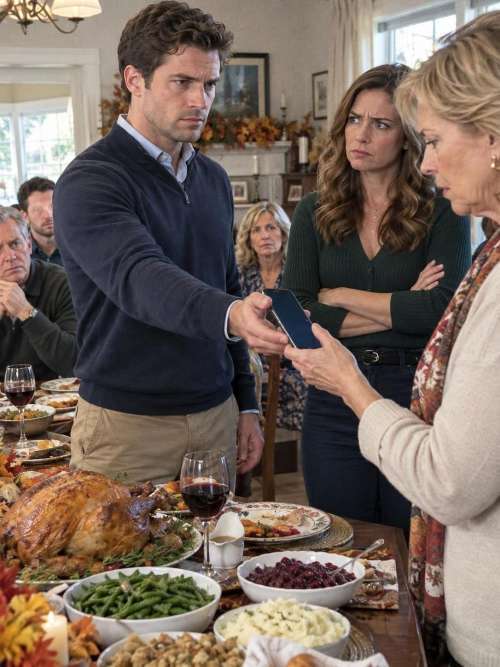
Sarah stood beside the refrigerator, still holding her phone. Ray had lowered himself into a chair. My mother remained near the table, clutching the old ledger against her chest.
Linda looked at me. “What did she say?”
I placed the phone face down.
“Your version just became worse.”
Ray looked toward the ceiling. “Linda, what did you do?”
She pushed herself upright. “I did what none of you had the courage to do. I kept this family alive.”
“You spent Zach’s trust,” Mom said.
“I kept him fed.”
“You took the money before he was old enough to know it existed.”
Linda turned toward me. “And what would you have done with it? You were a frightened child.”
“I would have trusted the adults who were supposed to protect me.”
That sentence struck her harder than an accusation.
Sarah looked at the fundraising page. “People think Zach agreed to pay everything.”
“Take it down,” I said.
“I tried.”
“Call the platform.”
“I already did. They need a written explanation from you.”
“I’ll provide one.”
Sarah swallowed. “The donors will want the money back.”
“Yes.”
“But some of it is gone.”
Ray’s head snapped toward her. “What do you mean, gone?”
She began crying then, not delicately and not quietly. The mascara beneath her eyes ran in black threads.
“I used part of it for the tuition deposit,” she said. “The deadline was today.”
Linda stared at her. “You spent donations?”
“You told me Zach would cover it!”
“I never told you to take it.”
“You told everyone he had agreed!”
The two of them turned on each other so quickly that I felt dizzy. The pressure they had aimed at me had finally found the place where it belonged.
I reached for my coat.
“Where are you going?” Mom asked.
“To the fundraising office.”
Linda stepped in front of me. “You can still fix this.”
“No. You can.”
“I have no money.”
“You have property.”
Her face tightened. “You want to sell the only things I have left?”
“I want you to sell the things purchased with my father’s money.”
Ray stood. “The restaurant is in my name.”
“Then you can sell it.”
He stared at me. “You’d take that from me after all these years?”
“I’m not taking it. You are returning what was never yours.”
He looked at Linda, and something in him collapsed. Not remorse. Recognition. He finally understood that the story had an ending he could not negotiate away.
My mother touched my sleeve.
“I should have told you,” she said.
I looked down at her hand. Her bracelet had a small broken clasp, and the chain kept catching against the fabric of her scarf.
“Yes,” I said. “You should have.”
She nodded, crying. “I thought if I stayed quiet, I could keep everyone together.”
“You kept me outside my own life.”
“I know.”
The words were small, but they were the first honest ones she had given me all evening.
I did not hug her immediately. Forgiveness was not a switch, and affection could not erase a decade of silence. But I put my hand over hers.
“That doesn’t mean you’re alone,” I said.
Linda laughed sharply. “Listen to him. He still wants to be the hero.”
“No,” I answered. “I want a clean account.”
I sent the documents to the fundraising platform, then wrote a public correction explaining that I had never authorized the campaign. I did not insult Sarah. I did not describe Linda’s lies in dramatic language. I attached the facts, the dates, and the signatures.
By morning, every donor had received a refund notice.
Sarah’s tuition deposit was lost. Her college gave her one week to arrange another payment, and she had to tell the financial office exactly where the original money came from. She moved out of Linda’s house before the weekend, taking only two suitcases and the cracked coffee cup she had used at Thanksgiving.
Ray listed the restaurant.
He called me once from the empty dining room, where the red vinyl booths reflected the light from the street.
“I thought you’d be happy,” he said. “You got what you wanted.”
“No,” I said. “I got what belonged to my father.”
“What will you do with it?”
I looked at the ledger on my desk. “Put it into scholarships for children who have lost a parent. The money was meant to educate someone. It should finally do that.”
He exhaled slowly. “You could have kept it.”
“I could have.”
“Why didn’t you?”
“Because I’m not interested in becoming the person who taught me to measure love in dollars.”
He said nothing after that.
Linda refused to sell the lake cabin at first. Then the bank’s repayment notice arrived, followed by the statement Elise had found. She could have fought the demand for years, but she knew what the documents would show and what every relative would ask her if she stayed.
She sold the cabin privately.
The restaurant sale covered the remaining amount. The old trust, recalculated with reasonable interest, was placed into a scholarship account bearing my father’s name. Linda signed the transfer documents without looking at me.
At the final meeting, she wore the same pearl earrings she had worn at Thanksgiving. One pearl was loose in its setting.
“Do you hate me?” she asked.
The room smelled of copier toner and warm paper. Through the glass wall, an assistant sorted folders into metal trays.
“I hate what you did,” I said.
Her fingers closed around the loose pearl. “That isn’t the same thing.”
“No.”
“Can we ever be family again?”
I thought about the question before answering.
“Family isn’t a word you use to collect payment.”
Her eyes lowered.
“But if you want a relationship with me,” I continued, “it begins with the truth. Not apologies designed to reopen the wallet. Truth.”
She nodded once.
I did not promise more than that.
My mother came with me afterward. We drove to the bank where Harold Vance had worked, though the sign above the entrance had changed years ago. Elise met us in the lobby with a small cardboard box.
Inside was the original warning letter, the duplicate ledger, and a brass key tag stamped with my father’s initials.
“My father kept these together,” Elise said. “He said someone would come for them.”
I turned the tag over in my palm. The metal was worn smooth where a thumb had touched it for years.
My mother began to cry again.
This time, I let her lean against my shoulder.
Not because the past had disappeared.
Because she had finally stopped protecting it.
Later, at home, I placed the ledger beside my computer and opened the scholarship account. The first recipient was a twelve-year-old girl whose father had died at a work site just like mine.
Her application included one sentence written in careful handwriting: I want to become the kind of engineer who makes dangerous jobs safer.
I approved the grant before I could overthink it.
Then I looked at the brass tag beneath my hand.
For years, my family had treated my father’s name as a locked drawer—something they could hide, borrow, and open whenever it benefited them.
Now his name was printed on a letter that would change a child’s future.
My phone buzzed.
It was a message from Sarah.
I am meeting with the college tomorrow. I am paying back every dollar. I know that doesn’t fix it, but I need to start somewhere.
I read it twice.
Then I answered: Start with the truth. The rest is yours to build.
I placed the phone beside the ledger and picked up the brass tag again.
On its back, beneath the initials, Harold Vance had scratched four words in tiny letters:
For the boy who survived.
I traced them with my thumb, and for the first time, my father’s last message was not buried in someone else’s drawer.
Missed the beginning?