
PART 4
Peter’s last words followed me through the hospital corridor.
The money would be released automatically.
Not because anyone had approved the loan, but because the forged paperwork had already passed the first electronic checks. A machine had accepted my stolen signature as more trustworthy than my family’s behavior.
Victor walked beside me while Harris and his partner headed toward the parking area.
“What can stop it?” I asked.
“Your written withdrawal, the fraud report, and the bank’s internal hold.”
“Can Peter place the hold?”
“He already did. But the person who submitted the file may try to override it.”
“Leonid?”
“Most likely.”
The automatic doors opened. Cold rain blew across the pavement and dotted the bandage above my eye. I stopped beneath the awning.
“What happens to Natalia?”
Victor did not answer immediately.
That hesitation hurt more than I expected.
“She knew,” I said.
“We know she was present when the document was notarized.”
“That is not what I asked.”
Victor looked at me.
“Knowing about a plan and understanding its full purpose are not always the same thing.”
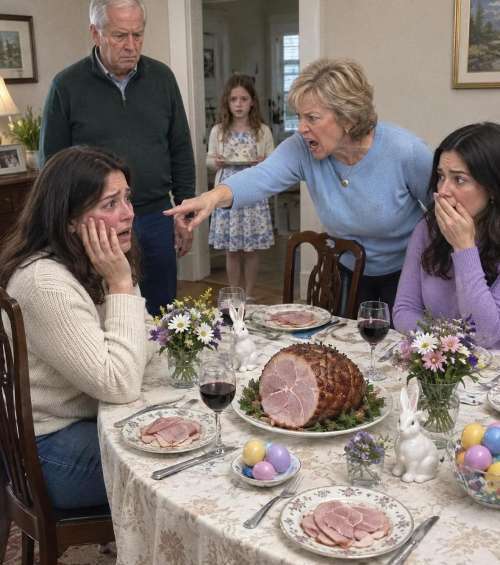
I thought of her face at the Easter table. She had not looked horrified when Father threw the glass. She had looked alarmed, as if a timetable had been ruined.
Still, she was the one who had told her children they would sleep in my house.
She had written Mariika’s name beneath my address.
I stepped into the waiting car.
The drive to my neighborhood took twenty minutes. The streets were slick, and the holiday decorations on the porches had begun to sag under the rain. Every turn brought me closer to the blue front door I had paid for, painted, repaired, and defended alone.
Victor spoke quietly from the passenger seat.
“There is something I have not told you.”
I tightened my hands around the steering wheel.
“Of course there is.”
“Your father did not begin this after Natalia’s rental was sold.”
“Then when?”
“Seven months ago. He contacted the bank to ask whether the house could secure a private loan.”
I felt the blood drain from my face.
“Why would the bank speak to him?”
“He claimed you had given him authority to manage your finances.”
I remembered the night he brought the insurance papers. His hand covering the top line. His voice insisting that I trusted him.
“Why didn’t you tell me?”
“Because I only found the inquiry yesterday. I needed proof that he had moved beyond talk.”
“And the glass gave you proof.”
“It gave everyone proof.”
We turned onto my street.
Two police cars stood outside my house. Their lights washed over the blue door in pulses of red and white. A locksmith knelt near the porch, a ring of tools spread across a folded cloth.
Natalia stood on the steps with Mariika pressed against her side. The child’s paper plate was gone, but a smear of orange frosting remained on her sleeve.
When she saw me, she broke away from her mother.
“Tía Solomiia—”
Natalia caught her hand.
“Stay here.”
Mariika looked at me with frightened eyes.
I crossed the yard.
“Let her come,” I said.
Natalia’s grip tightened.
“She thinks you hate us.”
“I do not hate her.”
“Then stop this.”
I looked past her at the suitcases in my hall.
“You brought children into a house you had no right to enter.”
“We had nowhere else to go.”
“You had your mother’s apartment.”
“She said the building was unsafe.”
“It is safer than a forged loan.”
Natalia flinched.
Behind her, Andrii came out of the study.
His face was gray.
“Natasha,” he said, “we need to leave.”
She turned on him.
“Leave for where? You said your father had handled everything.”
Andrii looked toward the police cars.
“My father said the loan would clear.”
“Because he used my name,” I said.
Natalia stared at me.
For several seconds, the rain was the only sound.
Then she whispered, “He told me it was temporary.”
“Who did?”
“Dad.”
“And the signature?”
She lowered her eyes.
“I knew he had copied it.”
My chest tightened.
“You knew?”
“I knew about the occupancy paper. I did not know about the bank transfer.”
“You stood in the notary’s office.”
“I thought it would make you let us stay.”
“You told your children they were moving in.”
“I thought you would give in.”
Her words landed quietly. That made them worse.
I looked at Mariika. She had moved behind the banister, clutching a small plastic rabbit with one ear bent forward.
“Did your mother tell you this was your house?” I asked gently.
The child nodded.
“Did you choose a bedroom?”
“The one with the yellow curtains.”
That room had belonged to me when I was twelve. I had painted it yellow with my own hands because Mother said bright colors made a girl look childish.
I crouched so Mariika could see my face.
“You did nothing wrong.”
Her lower lip trembled.
“Are we being thrown out?”
“No. Adults made a dangerous mess. Adults will carry it away.”
Natalia began to cry.
I did not move toward her.
Victor stepped onto the porch with a packet of papers.
“The bank has confirmed the hold,” he said. “The attempted loan is frozen. The occupancy filing has been rejected. The locksmith has changed every exterior cylinder.”
One of the officers approached Father, who had just come from the side gate. His coat was wet, and he still held the old brass key.
“Give me that,” I said.
He stopped.
“For what?”
“Because it belongs to me.”
He looked at the key, then at my bandage.
“It was a mistake.”
“No. The broken glass was a mistake. The key was a plan.”
His face tightened.
“I was trying to save the family.”
“You were trying to save the money.”
He glanced toward Andrii.
Andrii shook his head.
“Don’t look at me,” he said. “You told me the house was already promised.”
Father’s expression collapsed into fury.
“You wanted the loan.”
“I wanted to stop losing everything.”
“You were going to put the house up as collateral,” I said. “If it failed, what happened to me?”
No one answered.
The officer took the brass key from Father’s hand. The red cap was scratched white along one edge, exactly as I remembered.
Mother arrived behind him, wrapped in a raincoat over her Easter dress. She looked at the police, the suitcases, the locksmith, and finally me.
“Solomiia,” she said, “your father is sick with worry.”
I almost laughed.
“He was worried about losing control.”
“He is still your father.”
“And I am still his daughter. That is why he believed my name was something he could borrow.”
Mother’s mouth trembled.
“You could have helped Natalia without all this.”
“I offered her three months of rent.”
“You offered conditions.”
“Yes. She had to sign a lease and leave my rooms when it ended.”
Natalia turned sharply toward Mother.
“You never told me that.”
Mother stared at the ground.
There it was—the smaller betrayal hiding beneath the larger one. She had told Natalia that I offered nothing. She had made my refusal sound cruel because cruelty was easier to organize around than a boundary.
Natalia wiped her face.
“Where am I supposed to take the children tonight?”
I looked at her for a long time.
Then I pointed toward the driveway.
“Your mother can take them. Andrii can go to his brother. You will come with Victor tomorrow and sign a real rental agreement for the three months I originally offered.”
Natalia stared.
“After everything?”
“The children did not forge my name.”
“And after three months?”
“You leave.”
She nodded, crying harder.
It was not forgiveness. It was a boundary with a human face.
Father stepped toward me.
“Why are you helping her?”
“Because I refuse to become you.”
His shoulders dropped.
The sentence did not wound him because it was loud. It wounded him because everyone heard the difference between punishment and consequence.
Later, inside the entry hall, Victor gave me the final document from the bank. Peter Sloan had added a handwritten note confirming that the account named in the application belonged to Father and that Leonid had submitted the transfer instructions.
But Leonid did not get the money.
The bank’s hold stopped the release, and the attempted loan destroyed the trust of the only lender willing to refinance Andrii’s debts. Leonid’s private investors withdrew the moment they learned the collateral was fraudulent. The delivery company was sold to pay what remained, leaving him without the fortune he had expected to build from my house.
Father lost something different.
Natalia refused to speak to him after Victor showed her the full file. She learned that he had told her the bank would take care of everything, while hiding the fact that he had used her name to register the company receiving the loan.
She had been part of the scheme.
She had also been its shield.
Both were true.
The police did not drag anyone away that night. The matter moved into the hands of the bank, the notary board, and the people whose signatures had been misused. Victor handled the filings. Margaret gave her statement. Harris photographed the broken glass and the cut on my temple.
I gave them the original insurance form too.
The sheet Father had covered was still in my study, tucked beneath an old folder of receipts. My real signature sat at the bottom, innocent and familiar.
When I returned it to its drawer, I found a second object beneath it: a small paper plate, crushed at one corner, with a smear of orange frosting dried across the rim.
Mariika must have dropped it before leaving.
I carried it to the kitchen, where Natalia waited with her coat buttoned to the throat.
“She forgot this,” I said.
Natalia took the plate and stared at it.
“I’m sorry,” she whispered.
I believed that she was sorry for the children. I was not yet sure she was sorry for me.
“Tomorrow, bring every copy of anything signed in my name,” I said. “No explanations. Every page.”
She nodded.
“And Natalia?”
She looked up.
“If you ever call this my family house again, remember that family is not the person who gets the key. It is the person who tells the truth before the door is opened.”
Her fingers closed around the bent paper plate.
At the porch, Mariika waited beside her grandmother. Before getting into the car, she ran back and placed something in my palm.
It was the plastic rabbit, its bent ear carefully straightened.
“For your house,” she said.
I looked toward the entry table, where the old brass key now rested inside a sealed evidence envelope.
Then I closed my hand around the rabbit and heard Mariika call from the steps, “Aunt Solomiia, the yellow room is still beautiful.”
This time, I answered her with the truth.
“It always belonged to me.”
Missed the beginning?